We all played with toy-planes as children, but the tragedy for many Africans is that our politicians continue to have this plane fetish as adults. This fetish, a deep desire to have a national airline, comes at a great cost to our societies and upends our development priorities. A mantra from the 60s states that having a national airline is one of the key markers of sovereignty. But the airline business is cruel and heartless; it's a capital-intensive business with narrow margins, that leaves many of its players gasping for breath. The once-vaunted SAA has only been kept alive in recent years by massive injections of state-subsidies; the national airlines of Nigeria and Ghana went bust in the 90s; the Belgian state carrier SABENA went bankrupt in 2001; and it too was quickly followed into oblivion by the Swiss state carrier SWISSAIR in 2002. As you can see, the business model of the aviation-industry has no space for emotional ties to dearly-held mantras, or even any notions of national strategic interest.
The aviation business is capital intensive and merciless in its modus operandi: a single Boeing-767 costs $160M and must constantly fill 70% of its seats in order to break even (cost wise); the price of oil has been hovering at about $90/barrel for the past five years, and aviation fuel is at its highest price in a decade. The only airline companies that are prospering in this merciless environment are the airlines of the Gulf Arab States (which are backed by a bottomless pool of petro-dollars), and highly efficient flag-carriers like Singapore Airlines.
Having stated the above, any rational mind would probably inquire as to why a desperately-poor, developing country would waste scarce resources on a national airline. With all of our pressing needs, be it in health or education, why splash $160M on a brand-spanking new Boeing 767? It just doesn't make any economic and moral sense. Not only that, but African airlines (especially) have a very shoddy reputation in the aviation business, and AirZimbabwe (even more so) has an even shoddier reputation than most. Below, I have posted a short list of some AirZimbabwe's woes in the past decade (not in chronological order).
-- It was recently reported that for two months in 2009, the airline had flown without insurance (that's akin to driving a car without any brakes). Apparently it had defaulted on payments to an insurer.
-- It was recently reported that two of AirZimbabwe's A320 Airbuses were grounded at Joburg's OR Tambo Airport due to the unserviceability of the planes.
-- the airline also has in its possession three Chinese-made MA60 planes which remain grounded due to the fact that no-one (not the Zim Govt officials, the Zim public, or even the Chinese themselves) will get into such rickety contraptions.
-- In 2010, at the height of its woes, AirZimbabwe had four planes (of which only one was operational) and yet was still (almost comically) overstaffed with 48 pilots and 268 technicians!
-- In 2005 AirZimbabwe gave new meaning to the term "flying solo" when it flew a return flight from Dubai to Harare with just a single passenger. It would then break its own dubious record in 2012 when it flew a regional route to Joburg with no passengers!
The solutions to AirZimbabwe's woes are simple. First of all we need to pitch ourselves as the cheapest business-market in the Southern African aviation-market. This we must do by slashing the cost of airport landing-fees and taxes, and reducing or (removing) any flyover fees for flying over our air-space. Then the Zim Govt must sell off a majority-stake in the airline to a "strategic-partner", i.e a well-endowed purchaser. Ideally the present AirZimbabwe would cease to exist in its present form and be re-branded as a smaller offshoot of a major airline. Ideally, the well-endowed strategic partner would inject much-needed capital into the new AirZimbabwe as well as taking over its onerous $200M debt ($160M to creditors & $40M to its staff).
All long haul flights must be ceded to the better-run airlines from the Gulf Arab states, and the better-run African airlines like Ethiopian Airlines and Kenyan Airlines. The only long-haul route that should be maintained is the popular Harare-London route. Ideally, this new AirZimbabwe should focus on servicing regional routes (to Gaborone, Maputo, Lusaka etc) as well as flying to all the popular domestic routes (to Vic Falls, Kariba, Bulawayo etc).
The regional and domestic routes can be serviced by the much-smaller Embraer and Bombardier jets, which carry around fifty passengers and (more importantly) don't come with heavy price tags. And finally, the massive head-count at headquarters must be culled dramatically. The present AirZimbabwe is filled to the rafters with political appointees and useless dead-weights; they must be given their marching orders and shown the door!
Thank You/Ndatenda
Sunday, February 9, 2014


Thursday, December 5, 2013
Mandela Ndeupi Wacho (Now, Which One Is Nelson Mandela)?
I remember it like it was yesterday: for a few days, rumors had been circulating in Harare that the ANC's President was about to be released from prison; finally that day had come (Feb 11, 1990); it was a weekend and the whole extended family were gathered around the TV. My parents, brothers, cousins, an aunt, we were all gathered around the TV waiting for the liberation icon to emerge onto our (satellite) TV screen.
Finally, there he was! But no, that wasn't him. The Apartheid South African regime had kept all present images of Madiba under wraps. I, like millions of other Africans, had his much younger image of him in my head. The image of him (posted below) as a lawyer,

in a crisp, dark suit with his hair carefully side-parted...that was the image I had of Nelson Mandela. Alas, at the moment that he was released, and in the kerfuffle that ensued, no-one in our family living-room could quite make out who of the men on our TV screen was Madiba.
There was an ANC official who had rushed out ahead of the crowd and was busy directing affairs. "Uyo Mandela", (there he is) I shouted out, but swiftly, my older cousin retorted, "No, that's Ramaphosa!". Indeed, Nelson Mandela was right in front of us, walking hand-in-hand with his wife, Winnie Mandela, but for a period of thirty seconds or so, we just couldn't see him. Everyone was looking for the younger Mandela, the figure in their heads. Then Madiba and Winnie gave a Black-Power salute and that's when it dawned on all of us, collectively, that the old man holding Winnie Mandela's hand was none other than Nelson Mandela himself.
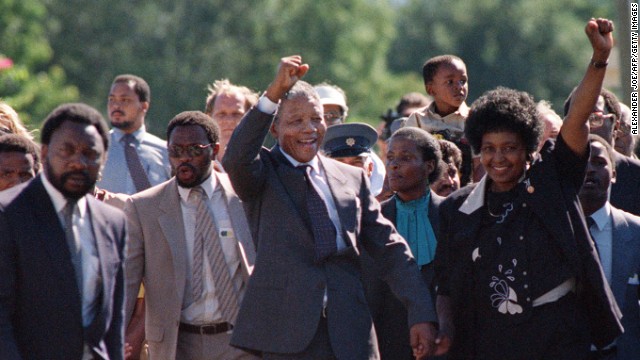
My father immediately slumped in his chair, wearing a deep frown on his face, and my aunt asked, "what have they done to him". Twenty-seven years in prison, being subjected to psychological as well as physical torture on a scale unimaginable to the ordinary human being, is the answer to my auntie's question.
This blogger cannot even imagine spending 27 hrs (one day!) in prison, let alone 27 years. But that's the task Madiba proposed to himself, and saw it fit that one day his people would be free and that they would live in a multi-racial, free and democratic South Africa. I salute the epic struggle and achievements of Nelson Rolihlahla Mandela and I say Hamba Kahle.
Finally, there he was! But no, that wasn't him. The Apartheid South African regime had kept all present images of Madiba under wraps. I, like millions of other Africans, had his much younger image of him in my head. The image of him (posted below) as a lawyer,
in a crisp, dark suit with his hair carefully side-parted...that was the image I had of Nelson Mandela. Alas, at the moment that he was released, and in the kerfuffle that ensued, no-one in our family living-room could quite make out who of the men on our TV screen was Madiba.
There was an ANC official who had rushed out ahead of the crowd and was busy directing affairs. "Uyo Mandela", (there he is) I shouted out, but swiftly, my older cousin retorted, "No, that's Ramaphosa!". Indeed, Nelson Mandela was right in front of us, walking hand-in-hand with his wife, Winnie Mandela, but for a period of thirty seconds or so, we just couldn't see him. Everyone was looking for the younger Mandela, the figure in their heads. Then Madiba and Winnie gave a Black-Power salute and that's when it dawned on all of us, collectively, that the old man holding Winnie Mandela's hand was none other than Nelson Mandela himself.
My father immediately slumped in his chair, wearing a deep frown on his face, and my aunt asked, "what have they done to him". Twenty-seven years in prison, being subjected to psychological as well as physical torture on a scale unimaginable to the ordinary human being, is the answer to my auntie's question.
This blogger cannot even imagine spending 27 hrs (one day!) in prison, let alone 27 years. But that's the task Madiba proposed to himself, and saw it fit that one day his people would be free and that they would live in a multi-racial, free and democratic South Africa. I salute the epic struggle and achievements of Nelson Rolihlahla Mandela and I say Hamba Kahle.
Saturday, October 12, 2013
Vinyl Album Covers
I often -- and I'm sure many others did too -- bought an album just for the cover-art. Album covers were a genre in their own right, and what we've gained in the ease and convenience of the MP3 format, we've lost in the artistic seduction and beauty of album cover-art. Please let me take a moment to share with you some of my favourite vinyl album covers.


The British group Soul ll Soul were another band whose album covers were always outstanding. The one that stands out though was the album cover for the 12 inch single Get A Life. "Simply outstanding", is the only description I can give for this wicked piece of album cover-art. It's as if they had hired Basquiat himself as artistic director for their album cover.


With all respects to Scarface though, I think for the generation of 80s teens, one couldn't find better album covers than those of Kool Moe Dee. Here he is below in his signature all-black outfit and wrap-around shades.

And finally, they say a picture is worth a thousand words. Well, if that's the case, the album cover for Timex Social Club's "Rumors" is a picture that tells it all, literally. A brilliant album cover, it would later be much used and borrowed for other artistic endeavors all over the world.

Tuesday, September 10, 2013
Zimbabwe Cabinet: The Good, The Bad & The Ugly
Zimbabwe's new Cabinet was announced today after a month-long wait. Let me just briefly unpack a few of the names and the issues surrounding the appointments (and non-appointments):
Amai Mujuru: Our Vice-President was clearly the winner in all of this. After wrestling supremacy of her own Mashonaland Central Province from another clique, she went ahead and stamped her authority on the make-up of the new Govt. Of-course President Mugabe (with the help of Chief Cabinet Secretary, Misheck Sibanda) is the final arbiter on all Cabinet appointments, but this Cabinet has "Amai Mujuru" written all over it.
Dzikamai Mavhaire: It's a mystery as to how a man who was once President Mugabe's chief critic, somehow managed to worm his way back into his good graces. Throughout the mid-80s and into the 90s he railed against President Mugabe's long reign, and yet, here he is back in Cabinet as Minister of Energy and Power Development. All I can speculate is that Cde Mavhaire "knows too much" and is too much of a loose-canon to be kept outside the tent, hence the need to have him tied down (inside the tent) with a Cabinet position.
Jonathan Moyo: If ever there was a man with nine lives then "The Nutty Professor" has to be that man. In fact, Harry Houdini couldn't touch this fellow when it comes to rebounding out of tight situations. At the Ministry of Information, the incoming Minister will have to bear with the obstreperous Permanent Secretary, George Charamba, as well as the equally verbose incoming Deputy-Minister, Supa Mandiwanzira. Expect fireworks at this Ministry as the three men (who are said not to get along) begin to squabble like junior wives in a polygamous household.
Walter Shamu: The appointment of the 67 year old Cde Shamu as I.C.T Minister is bizarre, to say the least. This has to be one of President Mugabe's strangest actions. A fiction-writer couldn't have made this one up.Ce n'est pas possible, the French would say. One wonders if our erstwhile I.C.T Minister owns a computer (or has ever sat down in front of a keyboard!)...anyway, let's move on.
Fancis Nhema: He's a decent fellow, calm and efficient, but are these the characteristics we need at the Indegenisation Ministry? Much of our industry is still in the hands of Westerners and White Zimbabweans and these folks do not yield an inch. I much preferred the "wrecking ball" approach of the previous Minister, Saviour Kasukuwere. A softly-softly approach might placate the markets, but that approach will not wrestle our industrial-capacity away from greedy Westerners. Having said that, let's see how Cde Nhema progresses in his new portfolio.
Josiah Hungwe: Poor old Josiah! The old Masvingo war-horse was rewarded for his seniority and loyalty with an obscure Ministry whose title is yet to be deciphered by the cognoscenti. What exactly is the job description for "The Minister of State for Liaising on Psychomotor Activities In Education and Vocational Training". What exactly are "Psychomotor Activities". Readers reading this paragraph would think that this writer has a vivid imagination and likes to make things up, but gentle readers, I kid you not! Such a Govt Ministry actually does exist in my beloved nation of Zimbabwe.
Amai Mujuru: Our Vice-President was clearly the winner in all of this. After wrestling supremacy of her own Mashonaland Central Province from another clique, she went ahead and stamped her authority on the make-up of the new Govt. Of-course President Mugabe (with the help of Chief Cabinet Secretary, Misheck Sibanda) is the final arbiter on all Cabinet appointments, but this Cabinet has "Amai Mujuru" written all over it.
Dzikamai Mavhaire: It's a mystery as to how a man who was once President Mugabe's chief critic, somehow managed to worm his way back into his good graces. Throughout the mid-80s and into the 90s he railed against President Mugabe's long reign, and yet, here he is back in Cabinet as Minister of Energy and Power Development. All I can speculate is that Cde Mavhaire "knows too much" and is too much of a loose-canon to be kept outside the tent, hence the need to have him tied down (inside the tent) with a Cabinet position.
Jonathan Moyo: If ever there was a man with nine lives then "The Nutty Professor" has to be that man. In fact, Harry Houdini couldn't touch this fellow when it comes to rebounding out of tight situations. At the Ministry of Information, the incoming Minister will have to bear with the obstreperous Permanent Secretary, George Charamba, as well as the equally verbose incoming Deputy-Minister, Supa Mandiwanzira. Expect fireworks at this Ministry as the three men (who are said not to get along) begin to squabble like junior wives in a polygamous household.
Walter Shamu: The appointment of the 67 year old Cde Shamu as I.C.T Minister is bizarre, to say the least. This has to be one of President Mugabe's strangest actions. A fiction-writer couldn't have made this one up.Ce n'est pas possible, the French would say. One wonders if our erstwhile I.C.T Minister owns a computer (or has ever sat down in front of a keyboard!)...anyway, let's move on.
Fancis Nhema: He's a decent fellow, calm and efficient, but are these the characteristics we need at the Indegenisation Ministry? Much of our industry is still in the hands of Westerners and White Zimbabweans and these folks do not yield an inch. I much preferred the "wrecking ball" approach of the previous Minister, Saviour Kasukuwere. A softly-softly approach might placate the markets, but that approach will not wrestle our industrial-capacity away from greedy Westerners. Having said that, let's see how Cde Nhema progresses in his new portfolio.
Josiah Hungwe: Poor old Josiah! The old Masvingo war-horse was rewarded for his seniority and loyalty with an obscure Ministry whose title is yet to be deciphered by the cognoscenti. What exactly is the job description for "The Minister of State for Liaising on Psychomotor Activities In Education and Vocational Training". What exactly are "Psychomotor Activities". Readers reading this paragraph would think that this writer has a vivid imagination and likes to make things up, but gentle readers, I kid you not! Such a Govt Ministry actually does exist in my beloved nation of Zimbabwe.
Saturday, July 27, 2013
Zimbabwe Election Campaign 2013: My Observations
Three days to go to Zimbabwe's elections and never a dull moment to the election campaign. I thought I'd share with readers a few snippets of some of the goings-on in this crucial election campaign.


ZimboNames: Foreign readers trying to follow the action will quickly be perplexed by some of the English-sounding first names they encounter. You see, in Zimbabwe, names like Reason, Jealous, Hatred, Lovemore and Witness are actually common first names. So in our political circles we have Reason Wafawarova (a political analyst), Psychology Maziwisa (a publicity guru for the ruling party ZPF), Stylish Magida (an opposition politician), Lovemore Madhuku (who runs a leading NGO), Jealousy Mawarire (a polittical operative) and Kisnote Mukwazhi (a Presidential aspirant).
Party Colours: All the political parties have their own colours to identify themselves, but the party-colour that has really piqued my attention is the bright-red worn by the main opposition MDC-T. In the picture below is the MDC-T's youthful organising secretary, Nelson Chamisa (dressed up as an Oakland pimp, in matching red shoes, suit and tie), dancing with the party faithful.
The British: Yes indeed, the British bogeyman has to make an appearance in these elections. Speeches made at campaign rallies of the ruling-party ZPF always site the Brits as the cause of most of the country's woes. It's the British this, and the British that. A Martian listening in on the radio would presume that these were the British elections!
The First Ladies: Not only are the Presidential candidates duking it out on the campaign-trail, but their spouses are engaged in a bitter campaign of their own. After all, it's their husbands' jobs that are on the line. The incumbent, Amai Grace Mugabe, has gone for the jugular and I'm scoring it (boxing-style) 7-5 in her favour against her rival Elizabeth Macheka. Below is a pic of the incumbent busting a move at a rally.

Below is a pic of the well-coiffed and manicured contender, Lizzy Macheka, on the campaign trail.

The SADC Observers: Many observing teams are being sent to observe these elections, with the A.U being the most prominent. SADC will also be sending its own observing-team, and no doubt, they will be observing the action...from the safety of Harare's local bars. You can always count on the SADC observers to catch up on a little gossip with their revolutionary comrades in Harare and to partake in a little (second) wife-chasing. After the elections are over, of-course, the SADC observers will deem the elections to have been "free-and-fair"...and all this "observation" will have come about without ever having left the comfy safety of Harare's watering holes.
The Numbers (just don't add up): A statistician would lose his mind trying to reconcile the figures being put forward by our electoral committee (Z.E.C). With an electorate of 6.4 million, why is there any need to print 8 million ballot papers? In some constituencies the number of registered voters are higher than registered residents. And when the votes are tallied, I'm sure some winning candidates will have received more votes than there are registered voters (in their constituency)! Tallying up the numbers in any African election is always fraught with difficulties, and let's only hope that a fair modicum of vote-counting is achieved in these crucial elections. Having said that: may the best man win!
Friday, July 19, 2013
Zimbabwe Elections: Should Be About Dynamism and Generational Change
On my first trip home to Zimbabwe from College in N.America (early 90s) I made my way to see my grand-mother in Gweru. On seeing me she asked whether I still rode my bicycle as I did before, since she had been told that North American Winters were quite cold. I told her that, yes, I still rode but now most of my riding was indoors, in a gym, and on a stationary-bike. This I did to keep trim. We then went on a back-and-forth in our (Shona) language as I tried to explain to her exactly what a stationary-bike was and how it helped me stay fit. Now, my grand-mother knew what a bicycle was and she knew what exercise was, but she couldn't compute why someone would ride a bike and go nowhere! "Where will you be going on this bike of yours", she kept on pressing me...to which I answered, "nowhere!'
I recalled this conversation with my late grand-mother this morning, when I was scanning the news updates on the upcoming elections in Zimbabwe. The Amadala (old geriatrics in their late 60s, 70s and 80s) who run the ruling party ZANU-PF, are clueless as to why elections are held in the first place. They know what elections are and they duly aim to win (by any means possible), but the concept behind elections, of democratic dynamism, is beyond these old geriatric folks.
Like my late grand-mother asking me "where I was going" on a stationary-bike, these old folks probably ask out aloud, "but who will replace us if we lose?". They cannot compute that losing, change, dynamism, and an infusion of fresh-blood are implicitly written into any democratic system. In fact this dynamism is really what democracy is all about: a chance to give newer faces (and a fresh, younger generation) a democratic-mandate to tackle the nation's problems. Not only that, but democracy implicitly allows the older ruling elites to depart from the stage gracefully. This quandary, of Africa's geriatric ruling elites not understanding why elections are held in the first place, is what's holding modern Africa back.
I recalled this conversation with my late grand-mother this morning, when I was scanning the news updates on the upcoming elections in Zimbabwe. The Amadala (old geriatrics in their late 60s, 70s and 80s) who run the ruling party ZANU-PF, are clueless as to why elections are held in the first place. They know what elections are and they duly aim to win (by any means possible), but the concept behind elections, of democratic dynamism, is beyond these old geriatric folks.
Like my late grand-mother asking me "where I was going" on a stationary-bike, these old folks probably ask out aloud, "but who will replace us if we lose?". They cannot compute that losing, change, dynamism, and an infusion of fresh-blood are implicitly written into any democratic system. In fact this dynamism is really what democracy is all about: a chance to give newer faces (and a fresh, younger generation) a democratic-mandate to tackle the nation's problems. Not only that, but democracy implicitly allows the older ruling elites to depart from the stage gracefully. This quandary, of Africa's geriatric ruling elites not understanding why elections are held in the first place, is what's holding modern Africa back.
Monday, July 1, 2013
The Dictatorial Route To Egyptian Democracy
The antidote to snake-bite is antevenom made from snake-poison. Similarly, to cure the need for authoritarianism and "strong-man" rule in Egypt, the Egyptian state must first have to be subjected to a harsh dose of iron-fisted rule by a strong leader -- and this heavy-handed rule must be buttressed by full-blown capitalism. Egypt neither has the resources (like Saudi Arabia) to re-distribute to a pliant populace nor can it afford Liberal Democracy on the empty bellies of its 85 million people, half of whom are illiterate and live on $2/day. After all, "you can't eat democracy", goes the old saying.
Here's my crude blue-print for what Egypt has to do to get itself out of its malaise. Firstly, a strong leader should be at the helm; someone who can rule with an iron-fist and who eschews all the niceties and trappings of democracy. Secondly, the strong-leader must appoint a small team of leading economists and technocrats to implement a top-down, root-and-branch overhaul of the Egyptian economy. Egypt has no choice but to go with the full-blown form of Capitalism. Demographic pressures on the ground and a woeful lack of resources means that it must literally go for broke with full-blown Capitalism. There literally is no other way!
The team of economists and technocrats must immediately implement the following economic measures: (a) all capital-controls to be lifted (b) all tariffs on capital-equipment to be removed (c) the Egyptian Pound to be made free-floating (d) all loss-making state-enterprises to be sold (e) all restrictions on the-ease-of-doing-business removed. In this business-friendly environment it should take no less than a week to start a business, and all the paper-work should be available online. (f) the removal of all food and fuel subsidies. I know this will be extremely painful, but these are the subsidies that are bankrupting the state, and the Egyptian state can ill-afford such extravagance. And finally (g) a flat tax of 15% to encourage Egypt's wealthy class to pay their fair share of taxes. Compliance with such a low flat-tax will increase (and not decrease) revenues in a developing economy like Egypt's.
After enacting the above measures the Egyptian economy will start to grow again, albeit from a low base. Egypt should be shooting for growth rates of between 7-10% per year (economic growth of 10% per year will double the economy every seven years). Egypt's poor masses cannot eat the empty rhetoric of democracy, but what they can eat is the sustained prosperity of a growing economy. Once the economy ticks, THEN incremental political and social reforms can be implemented. This is an important point: get the economics right first, and then tackle all other needed reforms. I repeat: this is a crucial point. Often nations like Egypt (stuck in a rut) try to "democratise" their way out of their problems first, before tackling economic problems, with the result being more misery and even anarchy.
A growing economy will feed on itself and a more prosperous citizenry will then demand a greater say in the running of their own affairs. Once the hypothetical "strong-man" hears these words from the streets, he will then know that it's time to allow for a more democratic political-dispensation. And that, my friends, is how Egypt can steer itself to a more prosperous and viable democracy, via the steely hand of a dictatorial-regime and prudent economic policies. If it sounds contradictory, it actually isn't. That's how South Korea and Chile steered themselves from misery to prosperity, and then gradually to viable democracy.
Here's my crude blue-print for what Egypt has to do to get itself out of its malaise. Firstly, a strong leader should be at the helm; someone who can rule with an iron-fist and who eschews all the niceties and trappings of democracy. Secondly, the strong-leader must appoint a small team of leading economists and technocrats to implement a top-down, root-and-branch overhaul of the Egyptian economy. Egypt has no choice but to go with the full-blown form of Capitalism. Demographic pressures on the ground and a woeful lack of resources means that it must literally go for broke with full-blown Capitalism. There literally is no other way!
The team of economists and technocrats must immediately implement the following economic measures: (a) all capital-controls to be lifted (b) all tariffs on capital-equipment to be removed (c) the Egyptian Pound to be made free-floating (d) all loss-making state-enterprises to be sold (e) all restrictions on the-ease-of-doing-business removed. In this business-friendly environment it should take no less than a week to start a business, and all the paper-work should be available online. (f) the removal of all food and fuel subsidies. I know this will be extremely painful, but these are the subsidies that are bankrupting the state, and the Egyptian state can ill-afford such extravagance. And finally (g) a flat tax of 15% to encourage Egypt's wealthy class to pay their fair share of taxes. Compliance with such a low flat-tax will increase (and not decrease) revenues in a developing economy like Egypt's.
After enacting the above measures the Egyptian economy will start to grow again, albeit from a low base. Egypt should be shooting for growth rates of between 7-10% per year (economic growth of 10% per year will double the economy every seven years). Egypt's poor masses cannot eat the empty rhetoric of democracy, but what they can eat is the sustained prosperity of a growing economy. Once the economy ticks, THEN incremental political and social reforms can be implemented. This is an important point: get the economics right first, and then tackle all other needed reforms. I repeat: this is a crucial point. Often nations like Egypt (stuck in a rut) try to "democratise" their way out of their problems first, before tackling economic problems, with the result being more misery and even anarchy.
A growing economy will feed on itself and a more prosperous citizenry will then demand a greater say in the running of their own affairs. Once the hypothetical "strong-man" hears these words from the streets, he will then know that it's time to allow for a more democratic political-dispensation. And that, my friends, is how Egypt can steer itself to a more prosperous and viable democracy, via the steely hand of a dictatorial-regime and prudent economic policies. If it sounds contradictory, it actually isn't. That's how South Korea and Chile steered themselves from misery to prosperity, and then gradually to viable democracy.
Subscribe to:
Posts
(
Atom
)